
Services
Shopify development
Custom Shopify stores for D2C and commerce brands, built to convert and to run smoothly for the team behind the counter, not just to look good in a screenshot.

Quick answer
Shopify development at The Tech Thingy means commerce builds made to convert, from a focused store to a larger catalogue or migration. It suits D2C brands launching or outgrowing a template store. A focused custom store is typically three to five weeks, with larger catalogues and migrations running longer, from content and catalogue handover.
Who this is for
Sound familiar?
- D2C and fashion brands outgrowing a template theme
- Stores that look fine but convert badly
- Brands selling internationally who need multi-currency done right
- Teams tired of an agency that disappears after launch
Is this the right fit?
We are a good fit if you are a D2C or fashion brand that has outgrown a template theme, or if your store looks fine but does not convert. We also work with brands selling across borders who need multi-currency set up properly, and teams tired of an agency that disappears after launch.
A focused custom store is typically three to five weeks, counted from content and catalogue handover. Larger catalogues and migrations run longer, and we set up redirects so you keep your rankings when you move.
What’s included
Real deliverables, not a feature cloud.
- Custom theme
- A store designed to your brand, not a bought template with your logo dropped in
- Conversion build
- Product, collection and checkout flows built around how people actually buy
- Apps & integrations
- Reviews, wishlists, subscriptions, shipping and payment apps, chosen and configured
- Performance
- A fast storefront, because speed is conversion on mobile
- International selling
- Multi-currency and market setup where you sell across borders
- SEO & migration
- Clean structure, redirects, and a safe migration from your old store
Question
How much does Shopify cost per month in India?
Shopify charges a monthly plan fee. At the time of writing (November 2026) Shopify's India plans start from about ₹1,994 a month for Basic when billed monthly, with cheaper rates on yearly billing, and Shopify regularly runs a low-cost first-months offer for new stores. On top of the plan you pay your payment gateway's fees, any paid apps, and a theme if you buy one. Check Shopify's India pricing page for current numbers before you budget.
Question
What are the disadvantages of Shopify?
The main ones for Indian brands: Shopify Payments is not available in India, so you use a third-party gateway such as Razorpay and Shopify adds a small transaction fee on lower plans; useful features often come from paid apps, so monthly costs creep up; and deep custom logic (complex B2B pricing, custom checkout rules) can be harder than on a custom build. For most D2C brands these are worth it for the speed and reliability you get.
Not sure which way to go?
Tell us what you are building and we will tell you honestly what we would do. 15 minutes, no deck.
How we work
The actual process.
- 01
Store audit and conversion map
We start with your catalogue, funnel and analytics, and find where shoppers drop and what is slow, before touching the theme.
- 02
Design to your brand
We design a storefront that carries your brand through product, collection and checkout, and get it signed off on real screens.
- 03
Build and configure
We build the custom theme and configure the apps and integrations you actually need, no bloat of ten apps doing one job.
- 04
Performance and international
We tune the store for speed on mobile and, where you sell abroad, set up multi-currency and markets properly.
- 05
Migrate and launch
We migrate your catalogue and customers safely, set up redirects so you keep your rankings, and launch with support on standby.
How a project runs
You talk to the people building your store, not an account manager. Before any work starts, the scope is written down along with the number against it, so you know exactly what you are getting.
While we build, you can watch the work on a live preview instead of waiting for a big reveal at the end. The aim is a working first version in weeks rather than quarters, which you then use and correct against.
Every engagement ends the same way: clean code, documentation, and every account in your name. You are never locked to us, and any competent team can pick up what we built.
Timelines
A focused custom store is typically three to five weeks; larger catalogues and migrations run longer. Timelines run from content and catalogue handover.
How we price
No surprises.
Every engagement is scoped before it starts. You get a written scope, a fixed number against it, and a payment schedule tied to what we hand over. Nothing moves without you agreeing to it first.
Scoped in writing
You see the full scope and the number before any work begins
Paid on delivery
Milestone payments tied to what we hand over, not to a calendar
Changes quoted first
Anything outside the agreed scope is priced and approved before we build it
Most projects are decided in one call. Tell us what you are trying to build and we will come back with a scope and a number.
Get a scope and a priceProof
We’ve done this.

A rich e-commerce experience for a premium women's fashion brand.
Read the case study
A high-converting store for an ethnic fashion label.
Read the case study
A Shopify store with order-sync and low-stock automation, no paid apps.
Read the case study
A custom Shopify storefront for a sustainable lifestyle brand, tied to its ERP.
Read the case study
A Shopify commerce build.
Questions
Before you ask.
Do you build on a template or from scratch?
We build a custom theme designed to your brand. We may start from a solid base for speed, but the result is yours, not a bought template with a logo swap.
Can you migrate our existing store?
Yes, including catalogue, customers and content, with redirects set up so you keep your search rankings through the move.
Do you handle international and multi-currency?
Yes. Where you sell across borders we set up Shopify Markets and multi-currency properly, which is more than flipping a switch.
Which apps will we need?
Only the ones that earn their place. We would rather configure four apps well than bolt on ten that slow the store down.
Will the store be fast on mobile?
Yes, and we treat it as a conversion issue, not a nice-to-have. Most of your traffic and most of your drop-off is on mobile.
What happens after launch?
We do not disappear. Ongoing support and iteration are available, and the store is built so any Shopify developer can pick it up.
What do you need from us before the build starts?
Your catalogue, product content and brand assets, plus access to your current store and analytics if you have one. Our timelines run from content and catalogue handover, so having these ready keeps the launch on schedule.
Proof
Work behind the words.
Apparel & Ethnic Wear
Jind Mahia
Brand identity, a multi-currency Shopify storefront rebuilt one collection at a time, and a shared content engine.
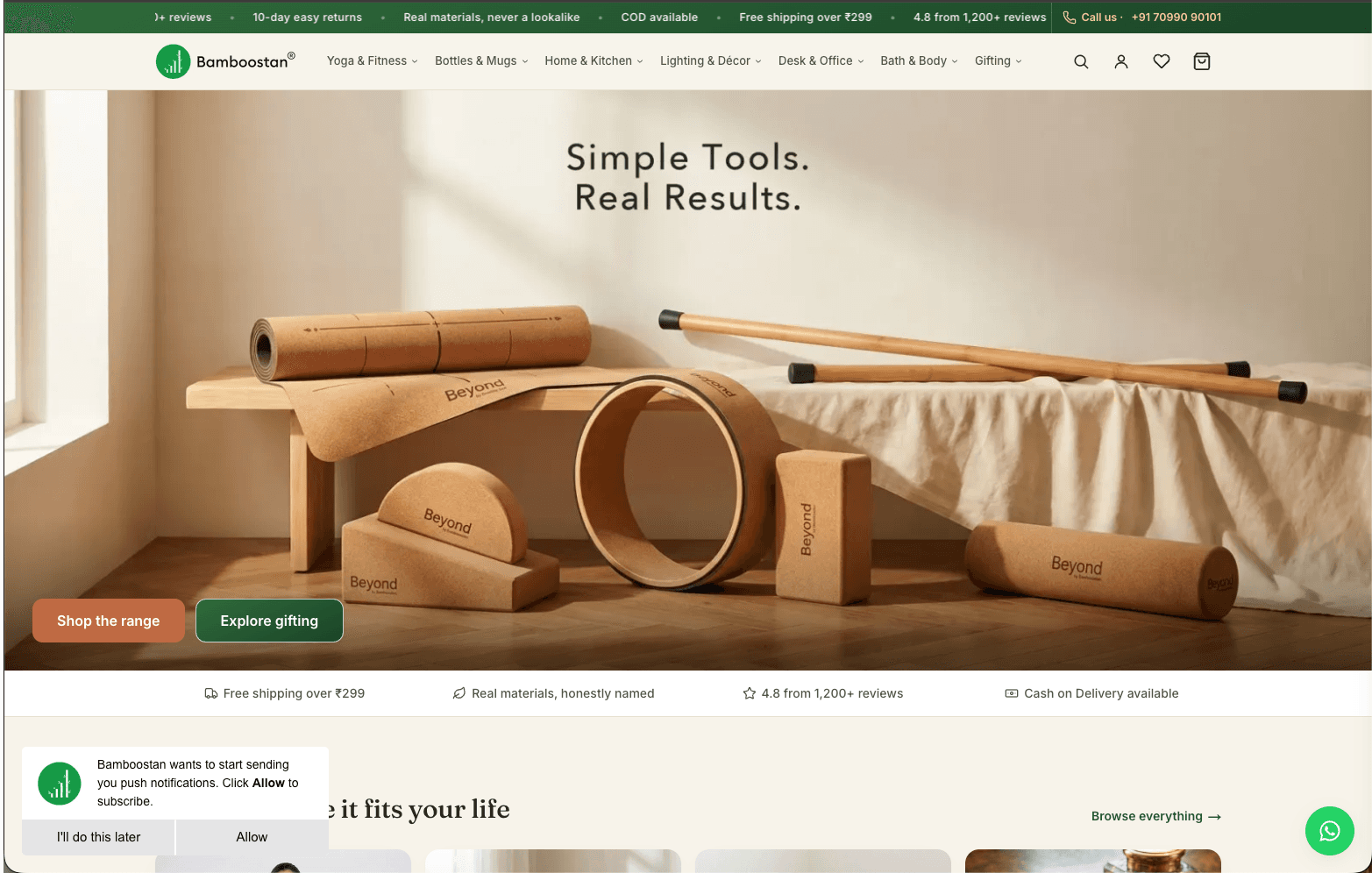
Sustainable Lifestyle & D2C Manufacturing
Bamboostan
Identity, Shopify storefront, an 88-model manufacturing ERP, a Flutter accounts console and an MCP server joining them.

Contemporary Womenswear
Laxakaar
A multi-currency store, a shared content engine, and a media pipeline that keeps a photography-heavy catalogue quick.
Questions people ask us
Straight answers
Is Shopify 100% free?
No. Shopify offers a short free trial and often a low-cost offer for the first months, then a monthly plan. You can explore and build your store during the trial without paying.
Is Zoho better than Shopify?
For selling online, Shopify is the stronger choice: it is built for online stores, has more themes and apps, and handles checkout well. Zoho Commerce suits businesses already running on Zoho tools who want everything in one place.
Amazon or Shopify, which is better?
They do different jobs. Amazon brings ready buyers but owns the customer relationship and takes a commission. Shopify is your own store: you own the customer data and the brand, but you bring the traffic. Many brands use both.
Etsy or Shopify, which is better?
Etsy works for handmade and niche products with its built-in audience. Shopify is better once you want your own brand, your own customer list and full control of how the store looks.
Is Shopify good for beginners?
Yes. You can launch a basic store without code. Where beginners usually need help is product photos, payments and shipping setup, and getting the first visitors.
Why is no one buying from my Shopify store?
The usual reasons, in order: not enough of the right visitors, product pages that do not answer questions about size, material or delivery, slow pages on mobile, and a checkout that surprises people with shipping costs. Fix traffic and product pages first.
Why do so many Shopify stores fail?
Most fail for business reasons, not technical ones: no clear audience, thin product pages, no plan to bring visitors, and margins that do not survive ads and returns.
How do I drive traffic to my Shopify store?
Start with what is free: Google search (good product and collection pages), Instagram, WhatsApp to existing customers, and marketplaces. Add paid ads once your product pages convert. See our digital marketing work.
Can Amazon fulfil my Shopify orders?
Amazon offers a multi-channel fulfilment service that can ship orders from other sales channels, and there are Shopify apps that connect to it. Check availability and fees for India before planning around it.
Still have a question? Ask us on a 15-minute call.
Keep reading
Where to go next.
Shopify developer in Mumbai
Custom Shopify stores for D2C and fashion brands.
ReadShopify store cost in India
What a store includes at each level, without the sales pitch.
ReadShopify vs a custom website
Which one fits your catalogue and how you sell.
ReadDigital marketing
Bring the right visitors once your store converts.
ReadWho we build for
Built for your industry.
Start a conversation
Tell us what you’re building.
A real conversation about your business and whether we’re the right team to help. Free, and no obligation either way.
Reach us directly
- Call
- +91 859-141-8661
- Studio
- Thane, Mumbai Metropolitan Region
- Response time
- Within a few hours, working days