
Case study
Bamboostan
A brand, a store, and the system that runs behind it.
Identity, Shopify storefront, an 88-model manufacturing ERP, a Flutter accounts console and an MCP server joining them.
The challenge
What they needed.
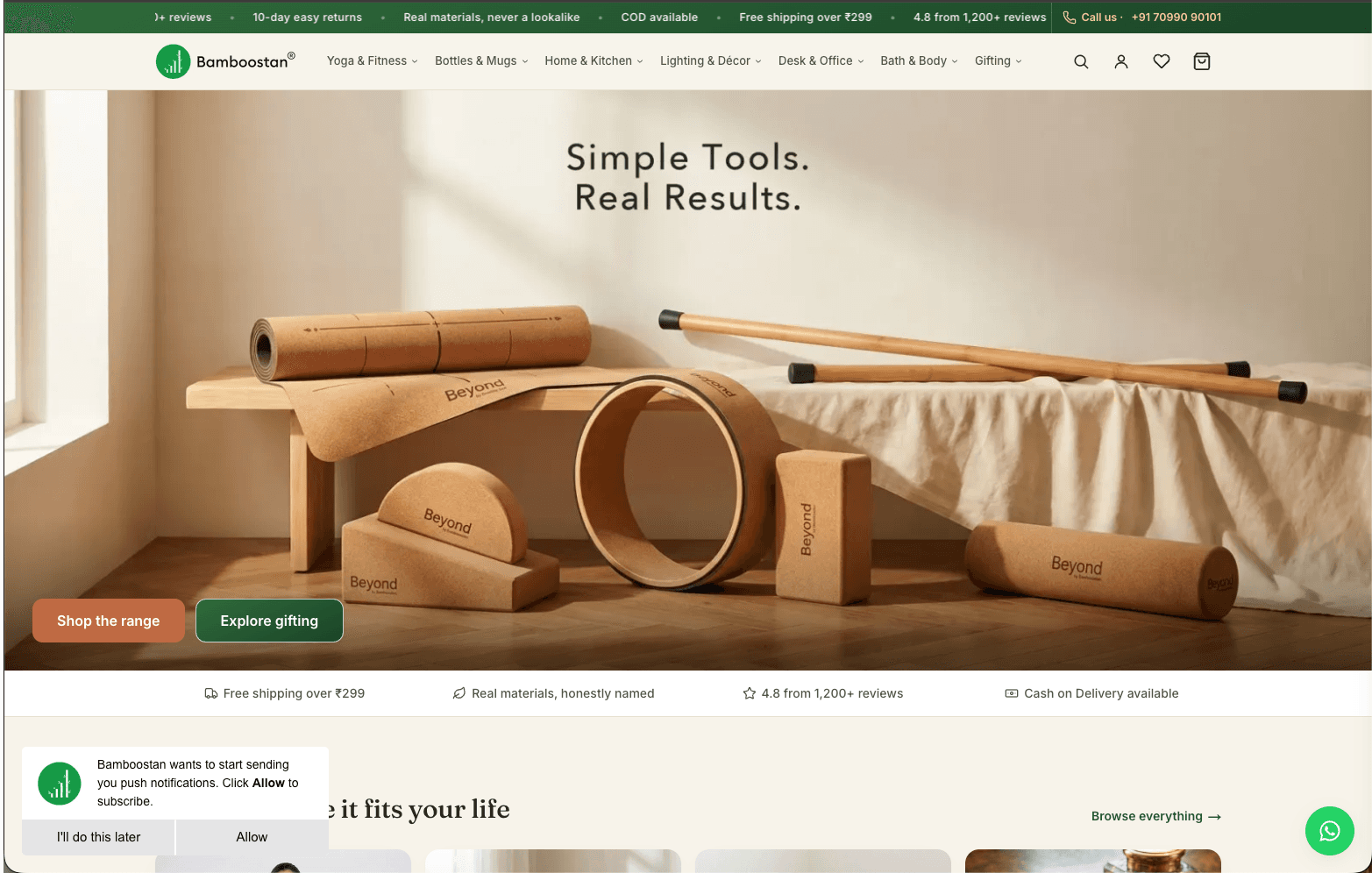
Bamboostan had a genuinely differentiated product: real bamboo, handcrafted in India, across fitness, home, drinkware and gifting. What they did not have was a brand, a way to sell online, or any system to run the business behind the storefront. Most agencies would have built the store and stopped. The harder problem was everything downstream of the order: what gets made, from which raw materials, by whom, packed into which shipment, sent with which waybill, and how the money comes back. That downstream chain is where most direct-to-consumer brands quietly break. A fitness mat and a drinkware gift box draw on different raw materials, different work orders and different packing, and once orders arrive from both Shopify and Amazon, the question of what to make, what to consume and what to ship has to be answered in one place rather than across inboxes and spreadsheets. Bamboostan also needed delivery estimates a customer could trust, vendor-grade records of materials consumed, and a way for the accounts team to reconcile remittances without being tied to a desktop panel.
Our approach
What we did.
We started with brand before touching a page, because the product philosophy of real materials and never a lookalike had to shape every decision that followed. Then we built outward from the storefront into operations. Five workstreams: brand identity, the Shopify store, a manufacturing and fulfilment ERP, a mobile console for the accounts team, and an integration layer connecting the ERP to Shopify so the two stopped being separate worlds. The catalogue itself is architected on Bamboostan's own Move, Live, Carry and Give framework rather than a generic category tree, with a gift box builder for curated seasonal orders sitting on top of it. Behind the storefront, the ERP spans eighty-eight models: bills of materials, work orders and design masters on one side, a consumables ledger with full movement history on the other, and a fulfilment chain of picklists, packlists, manifests, shipment batches and waybill management joining them. Pincode-level turnaround times feed realistic delivery estimates back to the store, Amazon sales and Google Ads data land in the same operations view as Shopify orders, and the MCP server moves inventory, catalogue and order data between the ERP and Shopify so nothing is keyed in twice. A separate B2B landing page and enquiry route handles wholesale buyers.
What one order looks like behind the store
When an order arrives, from Shopify or from Amazon, it lands in one operations view. From there the ERP knows which bill of materials it draws on, which work order makes it, and which consumables it uses, with every movement recorded in the consumables ledger. Picklists, packlists, manifests, shipment batches and waybills carry it out of the door, so the path from raw bamboo to a shipped parcel is traceable end to end.
Because the MCP server moves inventory, catalogue and order data between the ERP and Shopify, nobody types the same thing into two systems. And the accounts team reconciles invoices and remittances from the Flutter console on a phone, rather than waiting to get back to a desktop panel.
What we built
Everything that shipped.
- Brand identity: logo, colour system, typography, voice, packaging and an asset library
- Custom Shopify theme built to the identity, with the catalogue architected on Bamboostan's own Move, Live, Carry and Give framework
- Gift box builder for curated high-value seasonal orders
- Manufacturing ERP across 88 models: bills of materials, work orders, design masters and core specifications
- Materials tracking: consumable masters, inventory and a consumables ledger with full movement history
- Fulfilment chain: picklists, packlists, manifests, shipment batches, AWB management and fulfilment records
- Pincode-level turnaround times, so customers see realistic delivery estimates rather than a flat promise
- Amazon sales alongside Shopify in one operations view
- Google Ads campaign data pulled into the same system as orders
- Flutter accounts console, so invoices, remittances and reconciliation are not locked in a desktop panel
- MCP server moving inventory, catalogue and order data between the ERP and Shopify without re-entry
- Separate B2B landing page and enquiry route for wholesale buyers
Stack
What it was built with.
- Ruby on Rails
- Next.js
- Flutter
- Shopify
- Liquid
- PostgreSQL
- MCP
- Figma
- Google Analytics
- Meta Pixel
Inside the build
See it in action.


Outcomes
The results.
4.8 stars, 1,200+ reviews
Customer rating
88
ERP models
Bill of materials to shipped waybill
Traceability
Services used
Related reading
Shopify or custom: which one does your business actually need
The Shopify versus custom decision is not settled by your storefront. It is settled by your operations, what happens after the order. Here are the four questions that decide it in ten minutes.
Read TechShopify Store Cost in India (2026): Full Price Breakdown
What a business Shopify store costs in India, broken down by tier, apps, gateways and add-ons, plus the two things that really move the number.
ReadStart a conversation
Tell us what you’re building.
A real conversation about your business and whether we’re the right team to help. Free, and no obligation either way.
Reach us directly
- Call
- +91 859-141-8661
- Studio
- Thane, Mumbai Metropolitan Region
- Response time
- Within a few hours, working days