
Client project
Kleansweep
Operations platform for a multi-store laundry business.
Seventy-one models covering orders, production, logistics, procurement, payroll and customer wallets.
The challenge
What they needed.
A laundry business at scale is a manufacturing operation with a delivery network attached. Items arrive from many customers, get sorted into categories, pressed, packed, tracked and returned, while materials are consumed, staff are paid by output, and customers expect a slot they can rely on. Kleansweep needed one system covering all of it, across multiple stores and societies, rather than a booking app bolted to a spreadsheet. The pieces that usually get left out are the ones that decide whether the business is actually under control: who is on shift and what they produced, which consumables were used against which run, what each vendor is owed, and whether a given society's pickups and deliveries are landing in their agreed time slots. A platform that tracks orders but not production, payroll or procurement just moves the gaps somewhere less visible.
Our approach
What we did.
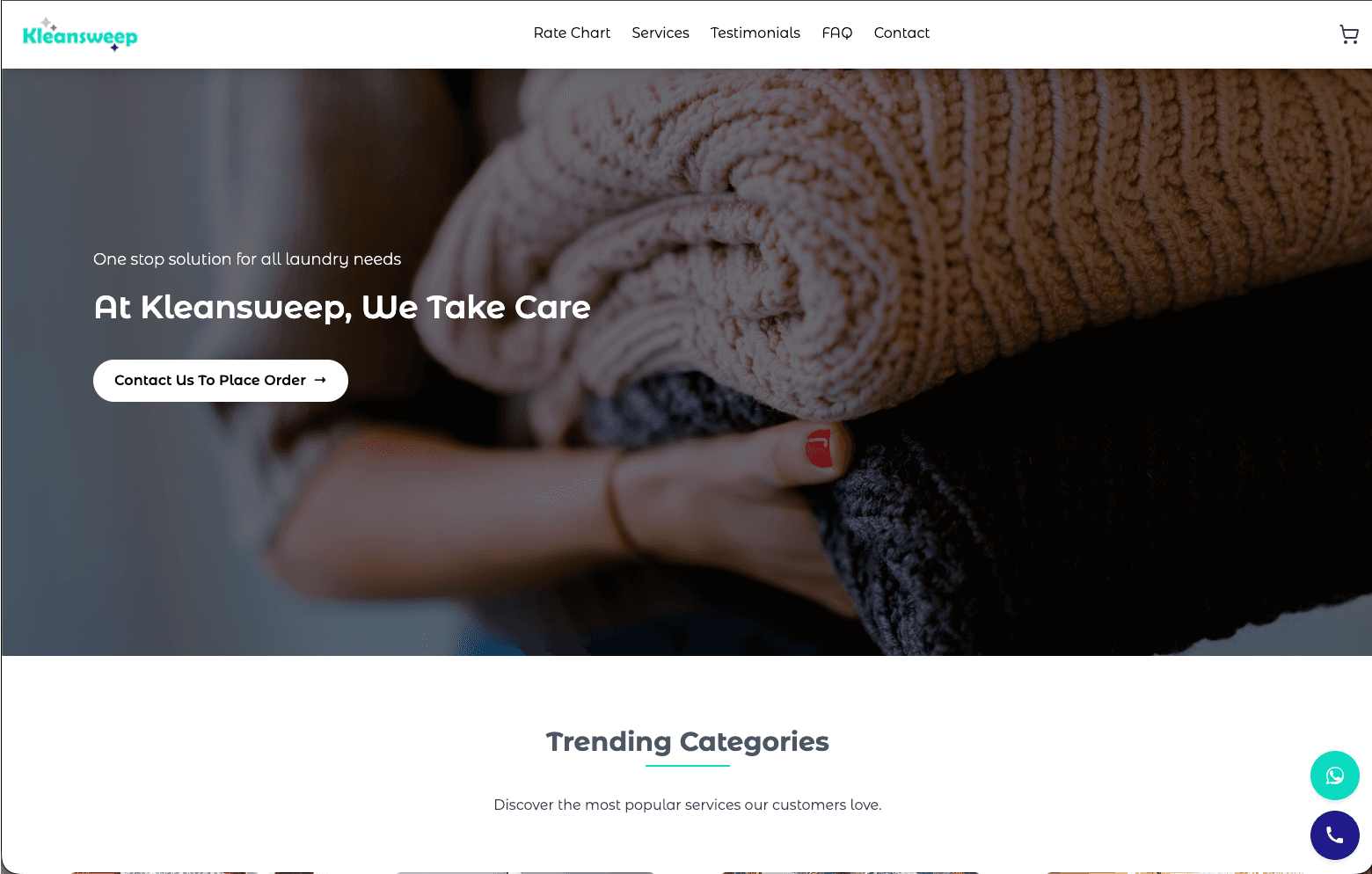
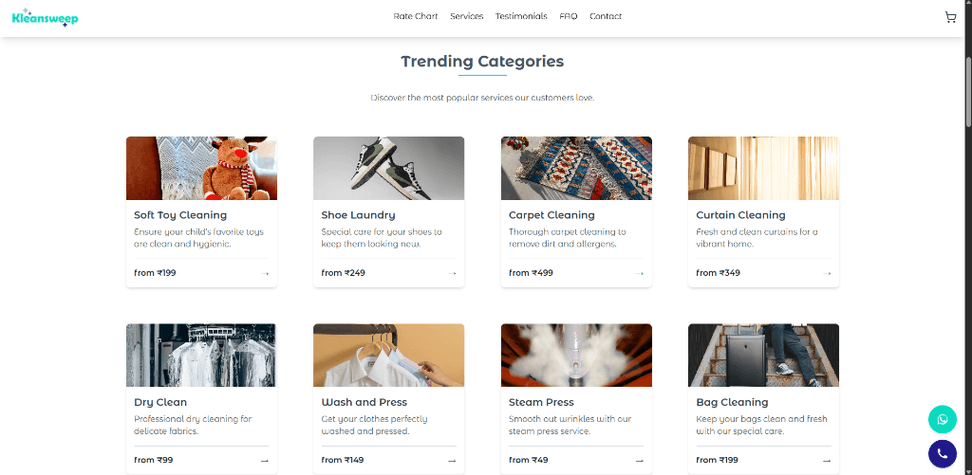
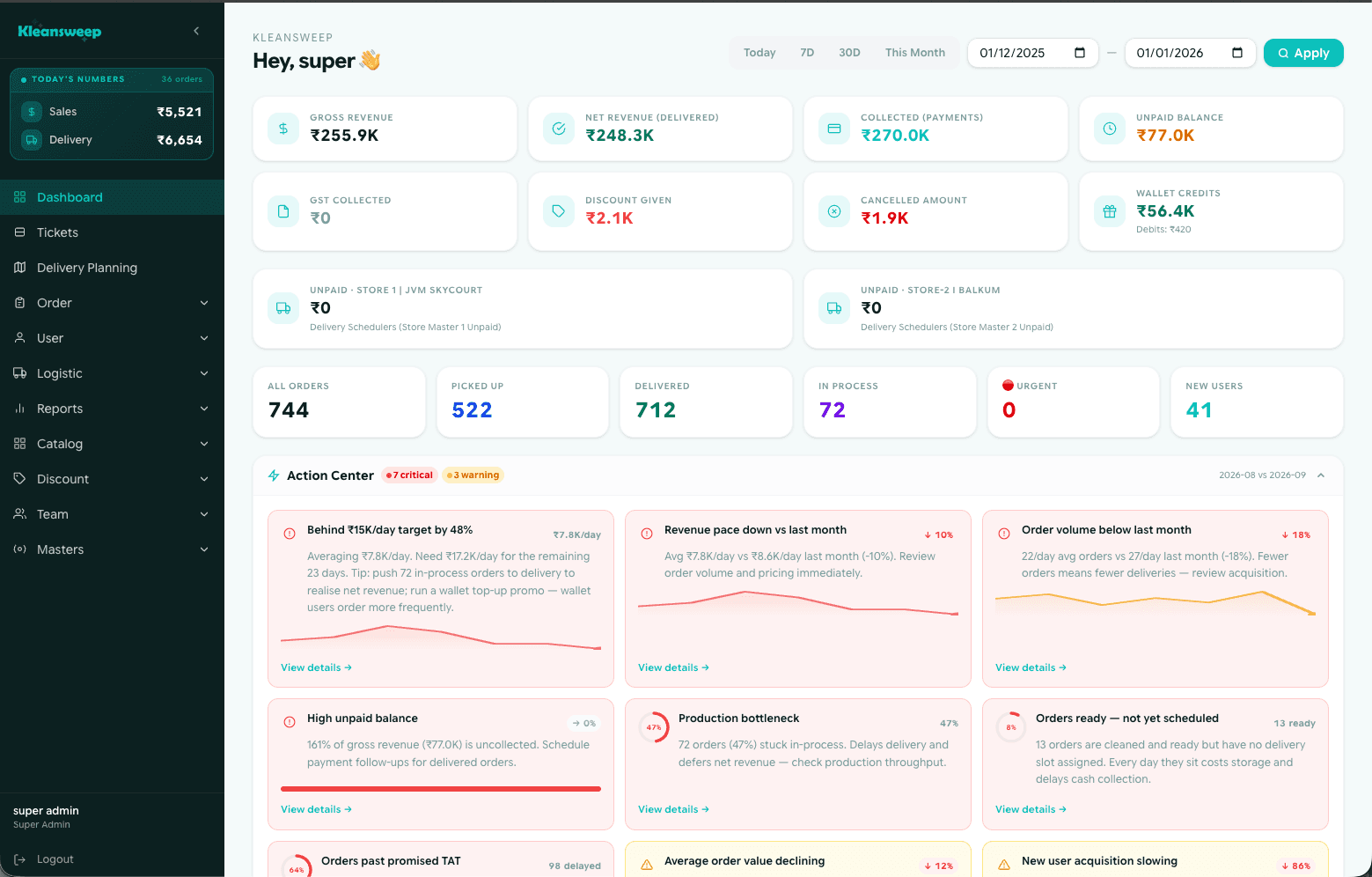
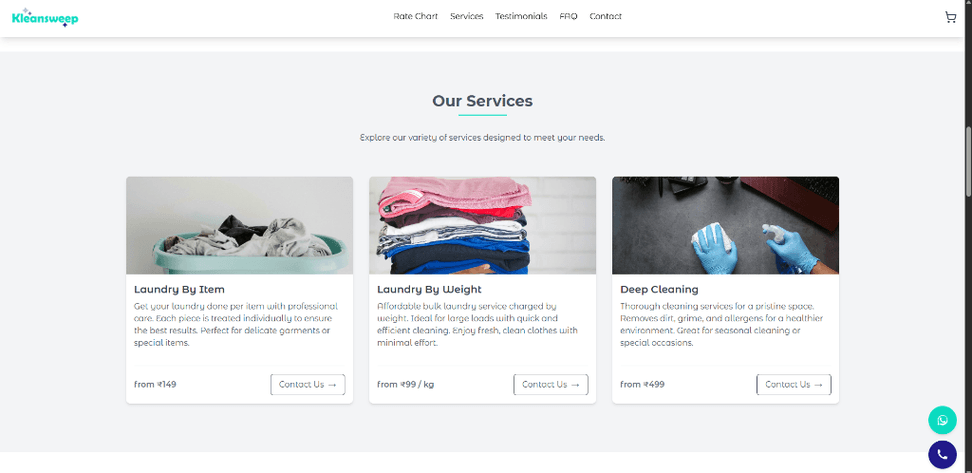
We built the whole chain as one platform: seventy-one models spanning orders and customers, production, logistics, procurement, people and stores. The design treats the business as what it actually is, a factory with a fleet, rather than as an ecommerce store that happens to involve washing. Orders, pre-orders and service orders carry through to bills and invoices with Zoho integration, while customer wallets, ledgers and top-up plans hold the money side. Production is modelled in its own right: daily numbers, press records, run plans and category codes, with materials and consumption tracked alongside. Logistics covers pickup and delivery schedulers, inter-store transfer plans, time slots and pincode data, and procurement runs purchase orders, goods received notes, vendors and payment reports. People get attendance, payslips and payslip payments, and every store and society is a master with admin users scoped to their own store. Separate applications sit on top: a delivery partner app, a customer Android app, an analytics service and the marketing site, so each audience gets the view it needs rather than one console stretched to cover everyone.
Why we treated laundry as a factory with a fleet
It is tempting to build a laundry business as an ecommerce store: take the order, take the payment, mark it delivered. But most of the cost and most of the mistakes sit between pickup and return, in sorting, pressing, packing, materials used and staff output. If the system does not see that middle part, the business cannot either.
Modelling production in its own right, with daily numbers, press records, run plans and category codes, puts that middle part on screen. Materials and consumption are tracked alongside, and attendance and payslips sit in the same platform, so output and pay can be read together.
Each audience gets its own app
Delivery partners, customers and store admins need very different things. A delivery partner needs the next pickup, a customer needs their order and wallet, and a store admin needs only their own store. Separate apps over one platform, with admin users scoped to specific stores, keep each screen focused while the data underneath stays in one place.
What we built
Everything that shipped.
- Orders, pre-orders, sales and service orders, carts, bills and invoices with Zoho integration
- Promo codes scoped by category and item with per-user usage tracking, upcharges and price lists
- Customer wallets, user ledgers, top-up plans and payments
- Production: daily numbers, press records and quantity tracking, run plans, category codes
- Materials and consumption tracking, packets, and items with tags and classifications
- Logistics: pickup and delivery schedulers, delivery plans, inter-store transfer plans, time slots and pincode data
- Procurement: purchase orders, goods received notes, vendors, vendor invoices, payees and payment reports
- People: employees, attendance, payslips and payslip payments
- Store and society masters, with admin users scoped to specific stores
- Support tickets with comments, document management and full activity logging
- Separate delivery partner app, customer Android app, analytics service and marketing site
Stack
What it was built with.
- Ruby on Rails
- Next.js
- PostgreSQL
- AWS
- Android
- Zoho
Inside the build
See it in action.
Outcomes
The results.
213 of 221, 96%
Features shipped
0.4 days, fastest on our books
Average close time
48 client-visible updates
Peak week
Services used
Related reading
What is an admin panel?
An admin panel is the private back office of a website or app where your team manages orders, users and content. Here is what it does, with real examples.
Read AutomationThe 8 Automations Every Small Team Should Have Running by Now
If your team is still doing these eight things manually, you're losing hours every week that could be recovered in an afternoon. Here's exactly what to build and how.
ReadStart a conversation
Tell us what you’re building.
A real conversation about your business and whether we’re the right team to help. Free, and no obligation either way.
Reach us directly
- Call
- +91 859-141-8661
- Studio
- Thane, Mumbai Metropolitan Region
- Response time
- Within a few hours, working days